
Why Some Midwives Are Cautious About Tracking Feeds
8 min read1,704 words
Why Some Professionals Feel Wary About Feed Tracking
It is worth saying clearly at the start that some midwives and breastfeeding advisors are cautious about feed tracking for understandable reasons. The concern is usually not that mothers should never remember what happened. The concern is that tracking can sometimes become too heavy, too rigid, or too central in a feeding relationship that already asks a lot from both mother and baby.
When a mother is exhausted, trying to learn her baby’s rhythm, and constantly checking whether things are “normal,” a tracking app can accidentally become one more source of pressure. Instead of supporting the moment, it can start to dominate it. Instead of helping a mother notice her baby, it can pull her attention back to the phone, the timer, the number, or the gap between feeds.
That is why this caution matters. It is not anti-technology for the sake of it. It is usually rooted in a very human concern: feeding should stay responsive, relationship-led, and grounded in the baby in front of you, not only in what an app says happened last time.
The Main Problem: Tracking Can Turn Into Pressure
One reason professionals can be hesitant is that tracking sometimes changes how a mother feels during the day. A simple record can slowly become a running scorecard. Instead of thinking, “My baby seems ready to feed,” she may start thinking, “The app says it has only been ninety minutes, so maybe I should wait.” Or she may feel guilty if the day does not look neat enough, predictable enough, or close enough to what she hoped.
That can be especially hard in the newborn period, where cluster feeding, contact naps, and unpredictable rhythms are common parts of life. Babies do not always organise themselves in a tidy pattern. If an app encourages mothers to expect a perfect routine too early, it can make a very normal feeding day feel like a problem when it is not.
This is part of why many professionals keep coming back to cues, context, and the lived reality of the baby in front of you. Numbers can help, but they should not become more important than observation. If tracking starts to create anxiety instead of reducing it, the tool is no longer helping.
Phones Can Also Get In the Way of Presence
Another reason for caution is much more practical: phones can interrupt feeding. A mother may already be juggling positioning, latch, comfort, hydration, and tiredness. If the process also requires unlocking a screen, opening an app, tapping start, stopping, editing, and checking the log, the phone begins to demand attention at the exact moment when the mother is trying to stay present.
That is not a small issue. During a feed, even tiny moments of friction can feel bigger than they sound. A phone can shift the emotional centre of the moment away from connection and toward management. This is the same broader tension described in Why Feeding Timer Lite Works Hands-Free With Siri, where the question is not whether logging is possible, but whether it asks too much from the mother while the feed is actually happening.
Some midwives and breastfeeding advisors are reacting to that exact problem. They are not necessarily rejecting the idea of remembering feeds. They are pushing back against systems that make a mother use the phone more in the middle of feeding, not less.
Why Feeding Timer Lite Can Be the Exception
This is where Feeding Timer Lite can be the exception to the rule. The difference is not that tracking suddenly becomes universally right in every situation. The difference is in how the app is used and what kind of behavior it encourages.
Feeding Timer Lite works best as a memory aid, not a command system. It is there to quietly capture what happened so a mother does not have to rely on foggy recall later. It is not there to overrule cues, push rigid spacing, or tell a mother that the baby in front of her matters less than a previous timestamp.
In other words, it can serve the mother without taking over the feed. That distinction matters. A light-touch tool can support confidence. A heavy-handed tool can erode it. Feeding Timer Lite is valuable precisely because it stays closer to the first category.
The Hands-Free Difference Matters
The strongest reason Feeding Timer Lite can be the exception is that Siri changes the experience of tracking. If the app can be used hands-free, it no longer asks the mother to keep handling the phone during the feed. That alone removes a large part of what many professionals dislike about tracking apps.
Voice support allows the app to do its job in the background while the mother stays focused on the baby. That does not make the feed mechanical. It does the opposite. It makes the technology quieter. It lowers the amount of tapping, checking, and admin that would otherwise intrude on the moment.
That is why the hands-free approach is not a gimmick. It directly answers one of the most reasonable professional objections. If tracking is going to exist at all, it should interfere as little as possible. Feeding Timer Lite moves closer to that ideal by letting Siri carry part of the practical burden.
If a mother reaches the point where she wants that kind of lighter support, there is a direct path to Feeding Timer Lite on the App Store without needing to navigate away and search for it later.
It Works Better When the Record Is Reviewed Later
Another reason Feeding Timer Lite can fit more comfortably with professional caution is that it does not have to turn every feed into a moment of analysis. The healthiest role for tracking is often simple capture now, reflection later. During the feed, the app remembers. Later, when the baby is sleeping or settled, the mother can look at the broader pattern with a clearer head.
That preserves the distinction between the immediate caregiving moment and the later thinking moment. It means the mother is not trying to read meaning into every number while she is still feeding. She can notice what happened first, then review whether there is a pattern when she actually has time and focus to do so.
That idea lines up closely with How Logging Feeds Gave Me Peace of Mind. A calm record can reduce guesswork later. It does not need to dominate the present tense of the feed itself.
Why Midwives May Still Find a Light Record Useful
The same professionals who are wary of obsessive tracking may still appreciate a simple record when it supports a better conversation. A mother who is exhausted may struggle to remember whether the baby fed six times or ten times, whether the hard evening started yesterday or three days ago, or whether the long stretch overnight is a new pattern or a one-off.
A light record can help shape that conversation without pretending to replace professional judgment. It gives mother and midwife something concrete to review together. It can help the mother explain what she has been experiencing. It can make a professional discussion clearer, calmer, and less dependent on memory alone.
That is where Feeding Timer Lite can be especially useful. It is not asking the mother to perform constant analysis. It is helping her hold onto enough information that, when she does speak to a midwife or breastfeeding advisor, she is not starting from a blur.
That balance matters. The app should support a conversation, not become the authority in the conversation.
The Real Exception Is the Mindset, Not Just the App
It would be too simple to say that Feeding Timer Lite is the exception merely because it has the right features. The real exception is the mindset it supports. If a mother uses it to stay calmer, remember the essentials, and review patterns later without treating the log as a rulebook, then it can fit alongside responsive feeding much more naturally.
By contrast, even a simple app can become unhelpful if it is used to chase perfect intervals, compare every day against an imagined standard, or second-guess the baby’s cues. The tool matters, but the relationship to the tool matters too.
Feeding Timer Lite is at its best when it stays in the background. That is also why the reasoning in How Siri Helps Me Track Breastfeeding With Feeding Timer Lite is so relevant here. The app adds value when it removes pressure from the feed rather than introducing more of it.
Why This Exception Can Matter So Much
Early motherhood is full of situations where “a little help” makes a meaningful difference. A record that is easy to keep, easy to ignore during the feed, and easy to review later can give mothers more confidence without asking them to hand their instincts over to a screen.
That is the version of tracking that many professionals are more likely to tolerate or even appreciate: not constant monitoring, not pressure, not rigidity, but gentle memory support. When used that way, the app is no longer fighting against responsive care. It is helping mothers stay oriented through tired days and long nights.
And if the mother decides that this lighter style is exactly what she needs, she can go straight to the Feeding Timer Lite App Store page at that point, rather than having to remember it later.
Closing Thought
Some midwives and breastfeeding advisors are cautious about tracking feeds for good reasons. They want mothers to stay responsive to the baby, not trapped by the phone. They do not want feeding to become a performance measured only in timestamps and intervals.
Feeding Timer Lite can be the exception because it does not have to be used that way. When it stays hands-free, quiet, and supportive, it becomes less like a control system and more like a memory aid. It can protect the moment of the feed, preserve a useful record for later, and support clearer conversations with professionals when needed.
That is what makes the difference. Not tracking for tracking’s sake, but a lighter form of support that helps mothers without pulling them away from the baby in front of them.

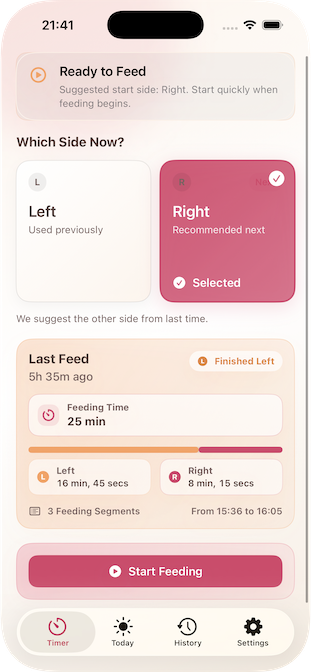
Feeding Timer Lite - Available Now
The live App Store version for mothers and caregivers who want quick feed timing, side memory, and a calmer overview of the day without clutter.

Breast Feeding Timer – Coming Soon
One-tap start and stop for left and right feeds, clear timers, and daily stats — designed for those quiet hours when every second counts.
Download Breast Feeding Timer App NowLast updated: 7 April 2026 at 22:18
Continue reading

7 Apr 2026
Why Midwives Tell Mothers Not to Track — And When a Quiet Exception Makes Sense
Some midwives are cautious about feed tracking because it can create pressure, rigidity, and too much phone focus. The exception is when a tool stays light, hands-free, and supportive enough to help mothers without pulling attention away from the baby.

7 Apr 2026
Why Feeding Timer Lite Works Hands-Free With Siri
Feeding Timer Lite is designed so mothers do not have to manage a phone in the middle of a feed. Siri can capture the moment hands-free, while the pattern stays ready to review later when there is real space to think.

5 Apr 2026
How Siri Helps Me Track Breastfeeding With Feeding Timer Lite
When one hand is holding the baby and the other is reaching for water, Siri can be the easiest way to start or stop a feed without breaking the moment.
Explore Expert Videos
Prefer watching? Browse our curated, doctor-led videos on key topics like breastfeeding, hunger cues, and routines.
Browse Videos